Translate

Wednesday, 12 March 2014

Changes

We enjoyed having our first circuit visit in Bolivia, and we had hoped that our group here in San Lorenzo might be made a congregation, but Jehovah had other ideas - still pretty exciting, but totally unexpected. Immediately following the circuit visit we flew out for New Zealand for a month of work to top up the coffers. We were notified by email that a meeting was held for the Elders of 4 congregations, and a fifth congregation has been formed from the 4. The new one is called Tomatitas, and this congregation will now look after San Lorenzo. Drew and I have been assigned as Elders in this new congregation, along with one of our Ministerial Servants who was made an Elder during the visit. This will leave a hole in the San Lorenzo group of course, and it will now revert to one meeting per week, and join Tomatitas for the other one. Lois and I intend to continue supporting San Lorenzo, so hopefully the workload in the congregation won't force us to abandon that goal. The territory is pretty exciting in San Lorenzo, and I can foresee that before too long there will need to be a congregation out there as well.
Well we are certainly enjoying being back with family in New Zealand. We are making the most of the food as well; I can't get enough of the seafood especially! Nevertheless we look forward to returning to our studies and of course our friends in Bolivia.
We have been asked to do presentations at meetings here to discuss how things are going in Bolivia, with the goal of motivating others to join us over there, so that's quite a privilege we are looking forward to. The territory is so much harder here in NZ but still Lois and I have managed to start studies since we have been back, perhaps our attitude and motivation have been tuned up a bit by the huge interest in the territory in San Lorenzo!
It was quite a learning curve flying out of Bolivia as well! We flew from Santa Cruz to Sao Paulo, then on to Dubai, Australia and NZ. Leaving Santa Cruz we went through customs 3 hours before our flight thinking it might be good to allow plenty of time. We had to wait in a queue for an hour and a half to pay our departure tax, then we had to wait in another queue to pay for the privilege of leaving the country (a separate "departure tax"), THEN we had to join another queue which was huge! Halfway through the wait they announced our flight was boarding. We asked if we could advance in the queue but were told no. Later they called our names, and we again asked if we could go to the front. Again, no. 10 minutes later an announcement that our gate was closed, and the plane was closed! 10 mins after that with another 30 minutes left in the queue they decided to rush us forward. We found at the front of these huge queues ONE guy checking luggage! He still gave all our stuff a thorough going over and then we literally sprinted to our plane and just managed get there in time to board. We ended up having to pay the equivalent of over $500 local currency for departure taxes. Don't you just love Bolivia! Once we got to Brazil, Dubai, Aussie and NZ everything was a breeze. Normal boarding, no extra taxes, quite boring really! Emirates really looked after us. We had a 10 hour wait through the night in Dubai, and they paid for a dinner, breakfast and accommodation in a nice hotel. I will happily pay extra to fly emirates from now on.
Well the weather here in NZ is nearly as hot as Bolivia at the moment, but apparently we have a tropical cyclone heading our way over the next few days.
We will be spending a few days in Dubai and Rio de Janeiro on the way home. I hope to do another post while here in NZ but this will depend on my workload. So perhaps next post I will talk about our trip home. Here are a few pictures of my granddaughter, NZ scenery and a link to a short video clip of a woman I am training to fell trees here as part of my work. Also a link to my first Bible Highlights in Spanish in San Lorenzo. See you next time.
Tree felling training
Bible Highlights


Tuesday, 18 February 2014

La Paz!

We have been in Bolivia now for three and a half months. Two weeks before we flew out of New Zealand we posted Lois' coffee machine to Bolivia so it would be there when we arrived. It cost us nearly $600NZ to post but we figured it was worth it seeing as Lois is a coffee addict! Well it arrived a day or two before us in La Paz. I won't bore you with the details but to cut a long story short we still don't have it. To start with they wanted to charge us almost $2000US in customs duty. After a battle to verify that the machine is second hand, (thank you Martin) the problem seemed to go away. However this is Bolivia, not on your life! It seems because the time has now exceeded 60 days, it has gone into unclaimed goods. Therefore when Martin and Louise invited us to go to La Paz with them, where the machine still is, we decided to accompany them and see the capital in all its glory, and hopefully resolve the coffee machine issue.
   Well it seems the machine is now a ward of the state! Martin is going to write to the president to see what can be done, but for this blog I am going to focus on the city of La Paz
   I have to say I was very impressed. Coming in from the south, you first go through the city of El Alto, which is to put it kindly, not the prettiest city in the world, but from there you come down the hill into La Paz which is nestled in a valley with stunning mountains (some of the highest in the world outside of Asia) as a backdrop. It really is quite a stunning sight when you come over the brow of the hill and see it in all its glory.
Pictures don't do it justice but here are a couple anyway:


Aaaand here is one photo of El Alto:

La Paz is really is quite a beautiful city, and apart from Hong Kong I don't think I have seen a better example of ancient meets modern. What is different here from Hong Kong though is that La Paz is not so much a dichotomy as an agglomeration, the old and the new live together! You find people living traditionally next to high rise buildings.
   La Paz is the highest capital in the world at almost 4000 meters so we expected to have a few problems with the altitude, but we had no problems at all. El Alto a couple of kilometres up the hill is the third highest city in the world boasting the highest airport in the world at somewhat over 4000m. On the trip to La Paz on the bus we passed through Potosi reportedly the highest city in the world, and passed over a mountain range at an altitude of almost 5000m before dropping into Potosi. (Incidentally passing through Potosi is probably a good move, not a pretty city at all) It can get quite cold at these altitudes so it pays to pack for cold even though it may be 40 degrees where you leave from!
   We really enjoyed the range of restaurants and markets in La Paz. One restaurant we went to had a French/Italian theme. We had a plate of breads and dips, deep fried squid (all complementary), a carafe of wine, a stunning main ( I had a perfectly cooked steak topped with foie gras) then a crème brulee to finish. This was a classy meal, not your run of the mill restaurant fare, and the total cost for both of us was around $60NZ ($50US)
   La Paz is an excellent place to find local handicrafts, tailor-made leather goods and almost anything for an incredibly low price (except coffee machines) Also interesting is that they are thinking of starting an English group here soon I believe.
  The trip to La Paz from Tarija on the bus was quite interesting as well. It normally takes about 18 hours and leaves mid afternoon, arriving in La Paz about 8 a.m. The bus was comfortable enough, all the passengers ride on the second deck, the lower deck being for freight and luggage. It did help that Martin booked the front seats for us so we had a good view and a bit more legroom. Buses here are everywhere. Travel is cheap too, it only cost us 190 bolivianos ($33NZ for the return trip - 36 hrs of travel) Be warned though that some drivers are a bit dodgy, and slow blind corner passing manoeuvres are not that uncommon! I have some on video but it takes so long to download them here, you will have to take my word for it.
   It is quite common here for people to blockade the road for one cause or another, and basically bring the country to its knees, so when the bus stopped behind a line of traffic at 1a.m and the driver turned the engine off, we assumed this was a blockade. Finally after 5 or 6 hours we walked forward to see the action, only to find a small slip had hit a bus almost pushing it over the edge, and completely blocked the road. This is basically the main highway through the country, but no-one did anything for hours. Finally a bus and then a truck tried to pull the stuck bus out. After a few dodgy scenes they got it out, then 4 guys started shovelling the slip of the road! Finally after nearly10 hours someone figured out we may need a machine! Soon thereafter we were on our way again slowly weaving through traffic. You can imagine the backlog of traffic after 10 hours on the main route! I am not sure how many trucks and buses we passed but it seemed like hundreds.


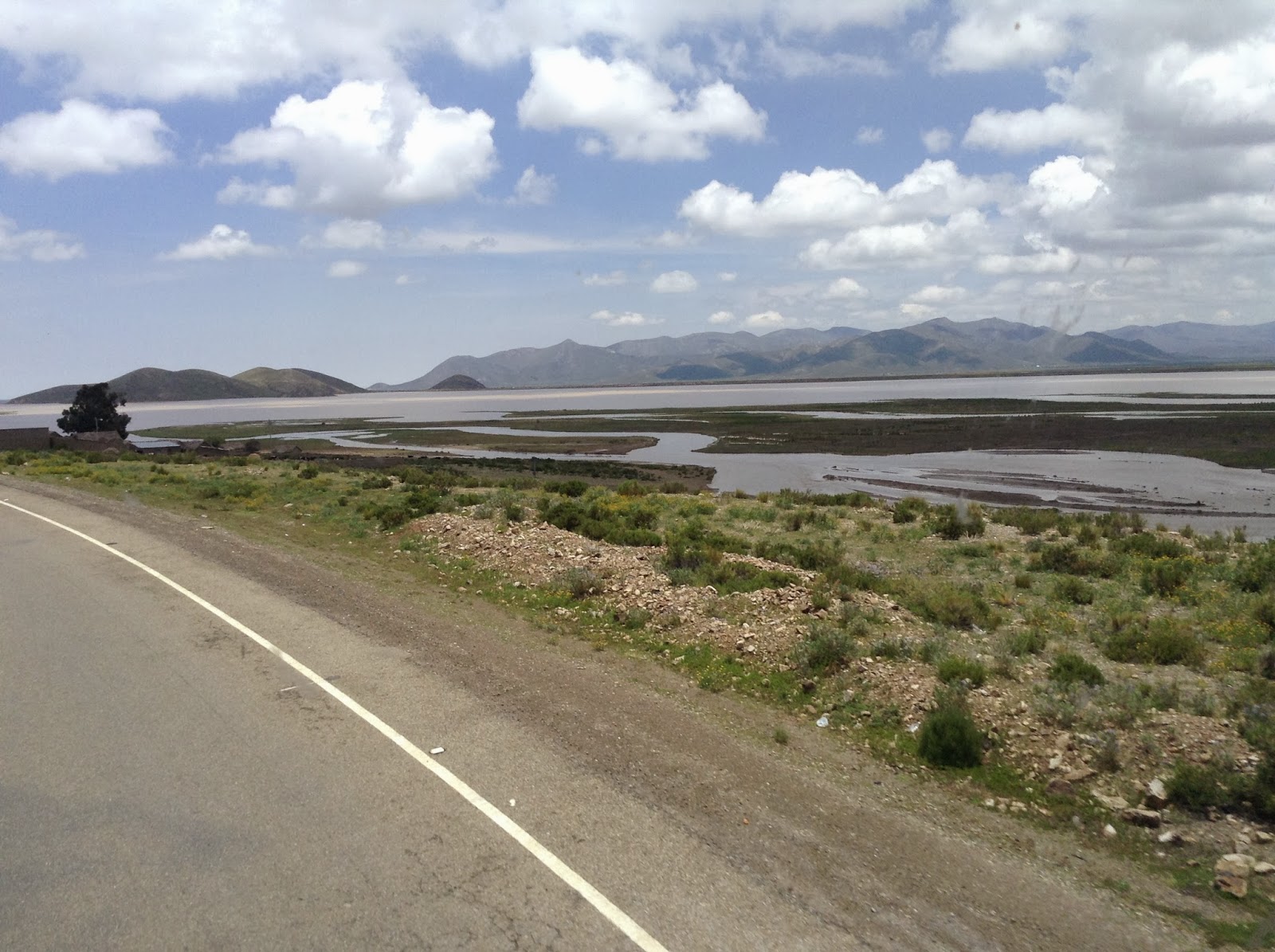
   One advantage for me having been held up for 10 hours, was being able to see the countryside, especially the altiplano in daylight. This is probably some of the remotest countryside in the world. People live very simply and traditionally, you see them out herding llamas and sheep, following them around like in Bible times. Here are a few pictures:

Is this the remotest soccer field in the world?


   So that's a flying visit to La Paz.
A few weeks ago I gave my first service meeting part in Spanish. If I start downloading it now it may be ready for my next post! Also we had our circuit assembly a few days ago, and in one week more we have the circuit overseer and District overseer visiting our group in San Lorenzo for one day. So next post will have a spiritual theme. We need to travel back to NZ for a month for work in March and we fly out the day after the visit by the CO and DO. Looking forward to seeing family and friends especially our granddaughter.
   See you next post!


Friday, 7 February 2014

The Rainy Season

Well it is finally here, a month or two late, but heavy rain on a regular basis. There are pro's and con's to rain of course. The temperature is certainly a lot lower on average, but still warm by New Zealand standards. It seems to have slowed the mosquitos down dramatically as well, perhaps due to the dearth of stagnant water to breed in. It does of course make for difficult preaching, even though it now seems to come at a similar time each day, around three in the afternoon. This is the time we normally head back out to start studies and return visits after siesta which is from 12  - 3.
   Bolivian people are certainly very hard workers as well as friendly and patient. It is hard to figure out their logic in some cases however. In New Zealand, houses have spouting and downpipes, which channel rain water into drains, leaving walkways and shop fronts free of falling water. Here it is quite different. A lot of work goes into installing short pipes here and there along the eaves or rooves which channel water -  you guessed it, directly into the middle of the footpaths and walkways. So when you get a torrential downpour, that is every afternoon, you have enormous cascades of water pouring onto passers-by every 20 meters or so. It defies logic that these were actually PLANNED on all buildings! It would have been far better to have had downpipes emptying straight onto the path, at least it wouldn't be falling on everyone. Even if they had nothing, at least the water would run gently down the walls, but no why not pipe it into gigantic waterfalls, and direct it into the middle of the walkways - who came up with this idea? Unfortunately I don't have very good pictures to show you, sometimes it looks like pedestrians are dodging through waterfalls every 20 mins, hopefully I can post a photograph in a later post.
   Another thing that defies logic is the way shopkeepers treat their customers. We were in a restaurant today for lunch and after ordering soup we wanted to order the main which is all part of the lunch deal at these "pensions' as they are called. Well we got a dirty look from the owner as though we had just insulted her. This is not uncommon here. Customers get in the way of people living their lives! Sometimes you will be half-way through a transaction at a shop and they will wander off to serve someone else, leaving you with money in hand waiting to pay! Also often you will see goods displayed but when you go to buy them they won't sell it to you because they don't know what price to charge. This happened to us yesterday. We saw some llama meat in a deli at the supermarket, and seeing as we were expecting to try this in Bolivia, we asked how much it was. "I don't know" was the reply. Well we wanted to buy it anyway, but no, we can't sell it to you, we don't know how much it is! Well why is it at the front of your display then, in front of all the other goods which you DO know the price of?
   The rain also coincides with the breeding season for snakes, and we are beginning to see a few now. I saw one a few days ago about a meter long in the middle of the road about 100 meters from our house. When I got to within a few meters of it, it shot into the grass so I didn't quite get my ipad ready in time to photograph it.
   Today we did some REAL country territory. I had a brother on the back of my bike with me and we had to cross a river. Last time we crossed it about 6 weeks ago it was about 100mm (4 inches) deep. This time it came half-way up the bike! Then we had acres of mud followed by some serious hill climbs through huge ruts washed out by rain. The rain certainly puts a different perspective on things. Every day after preaching I have mud all over my shoes and up my trousers. Lois just loves me for it!
I now wear gumboots preaching! You would get plenty of disapproving looks from publishers and the public in New Zealand, but here no-one bats an eyelid.  
   Speaking of bats, we have grapes growing over trellises outside our bedroom, and these huge moths which they call "mariposa de la noche" or butterflies of the night. Anyone who knows Lois will know she HATES them. They are so big they cover your whole face when they land on you. Because of the rain, and presumably to escape bats, they congregate under the grapes at night, sometimes dozens of them. Bats obviously eat them because we see wings on the ground in the mornings. I put mesh over our windows so we can leave the windows open at night, and the other night a bat got caught in the mesh for about 10 seconds. He was fortunate to escape because I have always wanted to taste since seeing it on a restaurant in Vanuatu in the  Pacific islands.
   Also in the rainy season
people grow peanuts here. Here is a picture of some
growing. Notice my dirty shoe on the left prior to buying
gumboots!


Well, we finally get to do some travelling in Bolivia. We need to go to La Paz to try to pick up Lois' coffee machine tomorrow. It takes about 18 hours on the bus, and costs about NZ$20 each. We rise to almost 5000 meters in altitude during the trip and pass through Potosi, the highest city in the world. Next post I will tell you how it went.


Friday, 24 January 2014

New Digs - New Responsibilities

First of all, sorry for the delay in posting this. We moved house and have been without internet for some time. Today we finally got back online.
Well we have moved into our new house in San Lorenzo. Here are some pictures of it:
The fig tree is on the other side of the house!


The lounge which we can use for meetings if we wish


Adobe oven on the right, gas on the left!
 
Our landlord, who we mentioned in the last post, hasn't missed a meeting since we first contacted him in the door to door work. He even travelled into the city to catch a meeting he couldn't attend here. He actually censured us for not studying with him regularly enough! The other day he told us it was the truth and he wanted to become a Jehovah's Witness. Since then he has been bringing a constant stream of his friends to us here at the house, for us to study with them. Some of them are turning into VERY progressive studies. I am amazed by the humility of Bolivian people. Our landlord is a paediatrician AND a dentist, and all his friends are professional people, but so willing to accept direction from the Bible!
   Well last Wednesday night we had our inaugural mid-week meeting in San Lorenzo. For the last month or so on weekends we have been getting 60-75 in attendance with only 20 publishers. We thought the mid-week meeting may be different, because the people work late in the countryside, but we got over 60! These are all interested persons other than the 20 publishers, so much potential. Here is a photograph of the attendees:
Our landlord Juan Carlos Flores, is towards the middle, in front of Synta and Drew in a white shirt leaning forwards.
   Well the hard work for Drew and I starts next Wednesday. We both have service meeting assignments, and I have the Bible Highlights. I guess that will be pretty much the norm from now on. It was a bit surreal the other night, we had an Elders meeting, me and my son-in-law! Anyway, Lois beat us to the draw, she had her first talk last Wednesday. She was very nervous, but did an excellent job as I knew she would. To conclude here is a link to view her talk. See you all next week.

Saturday, 11 January 2014

San Lorenzo

For a while now we have been trying to move to San Lorenzo, which is a small town of about 10000 people about 30 minutes drive from Tarija. We are in a congregation in Tarija called Guadalqivir, and this congregation sponsors the group in San Lorenzo of which we are a part. We have been looking for a house there for quite a while, but they were all either too expensive, too rudimentary (i.e. outside kitchen etc.) or too far out of town to be within reasonable walking distance. Well last week in the ministry we met a man at a door who invited us in. We discussed the Bible with him for about 20 minutes and he agreed to come to the meeting the next morning.
   Before we left somehow we got onto the subject of houses, and he offered us his house to rent. At first we thought we may as well look at it because some other witnesses in Tarija are looking for a house in San Lorenzo also. When we looked though, it became evident it was ideal for us. Three self contained bedrooms, a HUGE lounge, kitchen, even a separate toilet for guests. It is a little bit rustic in some ways, for example it has an adobe bread oven in the kitchen which works like a pizza oven, but it is very tidy and includes about a hectare of land running down to a stream. The house is about 800 metres from the central plaza. We mentioned we didn't have furnishings like a washing machine, stove, fridge etc. and he said he would furnish it for us. Before we knew it we had signed a contract on it for a year! It is costing us $250 US per month. Not cheap but not too expensive either for here! Tarija is about double the price, so for us it is perfect. As a bonus, our hall in San Lorenzo is the lounge of an English couple here, which is quite small. We get lots of interested people at the meetings and some have to sit outside in the courtyard. Our landlord (who did come to the meeting by the way, and intends to come again tomorrow) said we are able to use our lounge for meetings. We may end up doing that as it is twice the size.
   Anyway we have one meeting in San Lorenzo on Sunday, and attend the mid week meeting at Guadalqivir in Tarija on Thursday nights. Last Thursday Drew and I were called into an Elders meeting after the meeting. We thought it may be about our appointments coming through from the branch now that we have our residence visas. But no, it was to talk about forming a full congregation in San Lorenzo, now that we have two Elders there - Drew and I. Scary stuff! From the 17th of this month San Lorenzo will operate as its own congregation, although I guess formal recognition will come when the Circuit Overseer visits.
   So here we are, not even appointed yet, in fact we haven't even given a talk yet and we have a congregation to run... and we don't speak the language, why would we have a problem with that? Carl Smith we need you!!
   So a bit scary yes, but exciting, and a real privilege to be a part of. Actually I joined the school 2 weeks ago and have my first Bible highlights in 2 weeks time, despite not being appointed yet. Lois isn't very impressed as when I joined they added her name too and she has a talk before me!
   On a different subject, I finally got my motorcycle license. After they gave me the pass without me even having to answer a question or ride a bike, what a drama with paperwork! My receipt wasn't green which for some reason caused quite a ruckus. Apparently the receipt should be GREEN not WHITE! Who cares if it shows the right amount has been paid to the right people, it SHOULD be green! This honestly took half a day to sort out. Various managers had to be consulted until one was found who was either colour blind or mysteriously endowed with common sense. Also I had one form which had extra information on it. All the other forms I needed had my name and various other bits of information. But one form ALSO had my mother's maiden name on it. UNACCEPTABLE! In the end I had to go and reapply for another license without the extra information, and get fingerprinted twice more. Anyway I now have my license and a motorbike. I will post a photo of it next time.
   One last thing, we saw our first serpiente (snake) yesterday, it had just been run over by a car, but here is a picture of it. Apparently it isn't a venomous variety. That's all for this post, thanks for reading.
                                                     Lois preaching in serpent country!

Friday, 3 January 2014

It was the best of times, it was the worst of times...

Let's start with the worst of times;
We have been here since Nov 1st and just today finished the final step in gaining our 1 year visa. Numerous days of travelling all over the city paying this fee and that fee, getting this verified and delivering that form to that department. I think we have visited most of the police stations in Tarija, some several times. Local police checks, Interpol checks etc etc. We have given our fingerprints so many times I think my fingers will stay purple for the rest of the year! And all this after we had to return to Argentina to get the CORRECT entry visa so we could APPLY for the one year visa. Let's just say thank goodness that's over. Martin Rattray made it as easy as it could be, and I highly recommend you avail yourselves of his services if you plan to come here. He guided us through all the drama, and his fees were extremely reasonable.
   Once we got our visa, we had to apply for our carnet, i.e. an identity card everyone has to carry. More travelling around, but at least it involved electronic fingerprinting. Why can't the different departments talk to each other, I mean really, 6 different fingerprint samples? Oh well, today we received our carnets and it is over!! at last!!
   Now let's talk about Lois' coffee machine. We posted it from New Zealand prior to flying out and it cost us $600NZ (a 20kg package) We thought that was exorbitant, but hey she is worth it. Anyway it arrived here the same time as us but to another city, La Paz. The thing is customs wants us to pay about $1000US to release it! Their claim is it is liable to customs duty. We have had to provide proof of purchase, this form that form, etc, and we still don't have the machine. In fact it is still in             La Paz. Today Martin took us to the customs office here in Tarija to argue that it is second hand and for personal use. Martin even had a printout of the regulations which show we should not have to pay the fee. It seems we finally had a breakthrough and they agree it is exempt. However you only have 60 days to get anything out of customs, so we are running pretty close to the wind. We were told today the customs agent in La Paz will release it from customs on Monday, but we have to pay his "fee" and transport costs to Tarija from La Paz, despite having paid in NZ to send it to Tarija. Oh well lesson learned there, don't post stuff to Bolivia!
   Now the best of times;
Oh the dichotomy of Bolivia! Lois and I decided after much thought, to buy a motorcycle. Much of the territory our group has is beyond public transport. Most of this remote territory has never been preached to! Thus the need for a motorbike. Firstly I needed to get a license. You guessed it 20 places to visit, fingerprints etc. However normally getting a license involves studying, a test, a practical test and a night of instruction.
   I managed to get the local road code which seemed to focus strongly for some reason on not using the horn unnecessarily. EVERYONE here uses the horn unnecessarily. Right so I have to go and get a medical. The doctor asks me are you healthy? Can you see? "Yes I can" I reply. Next thing he hands me my medical form - passed 20/20 vision! No test, nothing! that was easy, but I wasn't looking forward to the test knowing my Spanish wasn't up to scratch.
   The instruction night involved apparently an "instructional" video showing possible distractions you may face while driving. Including.... A woman flashing her boobs, decapitated bodies... actually I haven't seen much of that on the roads to be honest! BUT before the video I needed to pass the theory. Well I go in and they realise I don't speak great Spanish. Result? "You won't understand the test so we may as well just give you your license!! I walked out with my license, being spared the video AND the practical! Oh just one thing I have to do, provide proof I haven't been involved in any accidents in Bolivia. Bit strange I thought seeing as I am APPLYING for a license, how could I have already been in an accident?
   An English brother here recently did his license (Ben Golding-Webb). He had a proper medical, a proper theory test. Had to watch the video, (hence I know what is in it) then sat the practical. He had never ridden a motorbike and knocked over every cone in the test area. Result? "but you know how to ride though don't you?" Result - Pass
   So yes Bolivia is definitely a tale of two cities!
I will post pictures of my new bike in future posts but in lieu of a copy of THE video, I will add some random unrelated photos to go with the general flow of things here.

  
Pigs here have a triangle of sticks tied tightly around their necks which still allows them to forage, but stops them getting through fences into crops. More humane than rings through noses I believe.

The hall at San Lorenzo where we attend meetings. It doubles as a dining room for Ben and Dawn Golding-Webb from England. Ben is seated at the rear end of the table.

Dawn Golding-Webb preaching with a friend in San Lorenzo's territory.

Wednesday, 25 December 2013

Transport

Before I start talking about transport, I thought you might enjoy a small story about an English couple in our group, Ben and Dawn Golding-Webb. They have been here a few more months than us, and speak much better Spanish. Ben had his first public talk in Spanish last week. Today I was out in the field service with Ben and a local sister. Now there is a verb in Spanish which is used quite often that has a completely different meaning if you insert an "r" in the middle. With the "r" it basically equates to the "s" word in English! The sister casually mentioned to Ben that this is the word he has been using for the 4 months he has been here - including in field service, and yes...in his Public talk where we had our 20 publishers, and 40 others mostly interested ones! Ben is quite devastated and understandably embarrassed.
Now for a more mundane subject - transport.
I was amazed when we arrived here, by how many taxis there are. It is no exaggeration to say that around half the vehicles are taxis! However when you come to appreciate that cars are incredibly expensive here, it is more understandable. For example even a clapped out really old car can cost $5000US. In equivalent local currency I guess that means an old car costs over $30000 Bolivianos! Even a second hand Japanese motorbike under 200 CCs can be $2000US.
Somehow quite a few of the locals afford vehicles, perhaps this is equivalent to buying a house in NZ, as most people have an extended family home anyway, not needing to purchase one and move out on there own.
Anyway the majority of the people here, including us, use taxis and trufis and micros to get around, even quite far out into the countryside. To get around most parts of the city costs in a taxi, 4 Bolivianos per person, and if it is right across town you may need to pay 5. It is curious that ere you pay per person. The same trip can net the driver 4 Bolivianos for 1 passenger, or 16 for 4 passengers! After 10 p.m. it goes up to 5 Bolivianos per person. You can also hire a taxi by the hour for around 30 Bolivianos which is handy if you need to make a lot of short trips while shopping.
We have read a lot about how the taxi drivers try to rip off tourists, but only once or twice have we had someone try to charge double or more. The trick is to refuse to get out until you get your change. Generally they are pretty honest. In fact one day Drew left his wallet in the taxi and he came back to find us to give it back! Perhaps more care is required in the bigger cities, I don't know we haven't been yet. It does pay however to negotiate a rate prior to departure if going further, and don't pay until you arrive. One day we paid first and the driver stopped at a petrol station and told us to get out. We were a bit wary thinking he was dumping us off, but then we saw a sign saying passengers had to disembark while refuelling.
Micros are another option, when travelling within city limits. They travel set routes, and have letters signifying the route displayed on the front. Unfortunately they don't have schedules here, so no-one can tell you what the route is! It was suggested to us to get on and trace the route on a map, doing so for each letter so that you learn where each goes to. It is worth doing because when you get on you pay 1.5 Bolivianos (22 cents NZ) no matter how far you are going. Be aware though that on weekends the route changes, and sometimes even during the week the drivers forget to change the letter on the front!
Trufis travel set routes also, but usually out of the city. They are basically vans seating about 12 people. You can flag them down anywhere on the route just like a taxi, and they are incredibly cheap. We use a trufi to travel from Tarija out to San Lorenzo where our group has its meetings. It takes about 25 mins and is probably about 15 kilometres or more, but it only costs 3 Bolivianos per person (54 cents NZ) Even a taxi is only 7.5 Bolivianos for this route per person, but still more than double the price.
Trufis go right out into the remote areas, and are indispensable when preaching. We get on a trufi until we get to a group of houses, get off to do them then catch the next trufi to the next part of the territory.
Soon we are going to buy a motorbike, because it gives far more flexibility for doing return visits, travelling beyond trufi range, and after they finish for the day which is usually 8 p.m. Sundays is a problem for us because they stop at 4 p.m. and most people want to study on Sundays because they are home, not in the fields. I will do a post later about the joys of shopping for a bike and getting your bike license in Bolivia!
To finish I thought I would include a few more photos of preaching in the country, and a video of our group singing a song at the end of our meeting on Sunday morning out in San Lorenzo. This video is for you Isobel Todd, I hope you enjoy it. Click on the link:

San Lorenzo group singing a Kingdom song

Yes it is a sheep on a leash in downtown San Lorenzo!
This is how fields are ploughed here. Sometimes you have to give way to them in the town, while they are moving between fields

Some of our brothers and sisters in the San Lorenzo group

It doesn't pay to leave your bike unattended. We carried Ben's bike into the river and piled it up with rocks

Me making an ass of myself!
 

Sunday, 15 December 2013

Preaching

Well if you are not a Jehovah's Witness, this post will probably not appeal to you. You may want to skip it altogether in fact. In the next few posts I will discuss transport and eating establishments here in Tarija.
We decided to come to Bolivia from New Zealand, because we heard there was a need in the ministry. I don't believe that any part of New Zealand's territory is worked less than once per year, and the vast majority is worked every few weeks or months. This coupled with the fact that there are plenty of publishers means that compared with Bolivia, NZ doesn't have a need at all for pioneers. In some places elders are needed, but again Bolivia has a far greater need for Ancianos (elders). Therefore we arrived here all keen to experience fresh, seldom worked territory. Our first outing in the field was a surprise to us. No-one seems to know how many people Tarija has as residents, but it seems to be between 100 000 and 200 000 people. There are 11 or 12 congregations, and a few groups attached to them. At our first field service group we found out that the congregation's territory is covered every one and a half weeks! It seems most of the other congregations have similar coverage, so we wondered why we were here to be honest. However once we began preaching, we found that studies were easy to start even with limited Spanish, and there is still much interest.
 Over the following few weeks we decided to try one of the groups a few kilometres out of the city. The group we chose is in a town of about 10 000 people about 20 minutes drive out of the city. Well, what a contrast! HUGE interest and a Huge need here for pioneers! With three Ministerial servants and no Elders, the group has a need as well for Elders, and I believe a lack of Elders is the only thing stopping it from becoming a congregation. No pressure Paul and Drew!
Regarding the territory, virtually everyone you offer a study to, accepts, and on occasion we have even had people cry because the are so overwhelmed that someone is willing to spend the time to teach them the Bible. It is so satisfying to study with people who genuinely want to learn the truth, even though it is mentally taxing struggling with the language. I cannot urge anyone thinking of coming here enough to just take the leap. Our group has large tracts of territory that has NEVER been worked! It takes us 20 mins to get there on a small bus that costs 50 cents NZ! Soon we hope to rent a house out there to get closer to the action. Be warned though, that although transport is available for much of the area, there is plenty of walking required.
If you are considering coming here to preach and have questions, feel free to ask via this blog, and if we cannot answer them we will endeavour to find the answer from others, and reply to you.
Here is an example of what you can expect. Three weeks ago was offering tracts during the campaign, and met a young lad of about 18. In halting Spanish I asked him if he wanted to study the Bible. "Yes I would" he replied. When I returned we did one part of the Good News brochure. The next time his father was there too, and wanted to join in. Today we did the third study and the whole family was there waiting, and was so appreciative of Bible truth. They had many questions, and we tried to use scriptures to answer them, especially when our Spanish ran short! I believe the will be at meetings within a week or two. - This is the norm, not the exception!
Also, the brothers and sisters are incredibly supportive, appreciative and friendly. It is just a joy to be here and be a part of it.
To conclude, here are a few photos of the territory we work in:


Monday, 9 December 2013

Lightning!

When we arrived here nearly five weeks ago, everything was dry and brown, and there was talk of the town running out of water. The rainy season was supposed to have started, but we were baking along with the landscape. Well in the last couple of weeks, the rain has gradually started to put in an appearance. It usually comes in the evening, sometimes for an hour or so, and sometimes quite heavy for most of the night.
   I have often heard of tremendous electrical storms that happen frequently even without accompanying rain in some parts of the world, and have always wanted to see a full-on version. Once in Sydney, Lois and I were staying at a hotel on circular quay and we got to see an impressive spate of lightning, we even saw one bolt hit an airliner coming into Sydney. Unfortunately though, the lights of the city and the lack of access to the roof of the hotel, detracted from the spectacle somewhat.
   Well if you want to see a true electrical storm, in all its glory, come to Bolivia! We have been treated to some absolutely breathtaking displays of Jehovah's power. Almost every night for at least 30 minutes, sometimes for several hours, the night sky erupts with an unbelievable volume and array of lightning. Forked lightning, lightning between clouds, you name it, we get it!
   In New Zealand, electrical storms are reasonably rare, and the time between bolts is usually quite long when we do get them. I have often wondered how many hours photographers spent to get a shot of lightning discharging, well in Bolivia it is only measured in minutes!
   We live in a second storey apartment, and a third storey is under construction, with just the floor so far completed. The first night we had lightning, we shot up on the roof to watch. Within minutes my daughter Syntyche got this shot
 
It can be a bit freaky standing on a roof with lightning flashing all around you, but we took comfort from the fact that there was reinforcing steel extending up around the walls which was higher than us!
   Some nights the bolts are 30 seconds or so apart but most nights there is hardly a second or two between them. About a week ago there was a storm on the horizon where there was virtually no time when lightning was not discharging somewhere! It was like a fireworks display, and it went for over two hours! It is hard to imagine the immensity of the energy that must have been discharged during that storm. I have a short video of it here - follow the link. Can't wait for one like that to happen right overhead! Remember as you watch it that I only filmed a segment of the sky, so the amount of lightning was way more than you see in the video. The second link is to a short clip from another storm. Lightning was happening all around, but I only managed to be in the right place once.
Storm
Lightning bolt

Well next post I think it is time I talked about the reason we came here, preaching. What is it really like here in the ministry?

Thursday, 5 December 2013

The markets

Well shopping is certainly vastly different here to what it is in New Zealand, or any other parts of the western world that we have visited. Supermarkets here are rare, small and not necessarily the cheapest option. Economies of scale seem to have by-passed Bolivia! Also, you will not find a fruit and vegetable section, nor a butchery in supermarkets here, and the deli is tiny. This is because people do the bulk of their shopping at the open air markets like the main one here in Tarija, called Campesino market. The produce may not be primped up to look enticing like in western supermarkets, but it is always fresh and the biggest advantage is flavour. Because it is picked to go straight to market, it doesn't have to be picked before it is ripe, or treated with chemicals to keep it fresh.
   In the west you can buy almost anything you need at the supermarket, here the same applies to the open air market. You can even buy donkeys here! Plus because there are so many vendors, healthy competition is alive and well which makes prices very reasonable. If you develop a rapport with some of the vendors, they get quite friendly and even give you little free add-ons for being a regular customer.
   We thought we were pretty up the play with our Spanish numbers, but here they often deal in unusual weights, not necessarily just Kgs. Also we didn't really study up on fractions which can cause a few dramas, for example we managed to purchase quarter of a Kg of cumin the other day because of not knowing fractions! Oh well it only cost us about $2 NZ, and surprisingly we seem to be ploughing through it quite rapidly.
   The scariest part of the market is the meat section. There are about an acre of small stalls all selling meat hanging in the open air at 35 degrees Celsius! Apart from the smell and fly blown meat, there are buckets of offal, heads of animals, you name it! There are a large number of butcheries up town however, that refrigerate their meat.
   Just behind the meat market is an eating establishment, there appears to be several throughout the market, obviously not designed for tourists, the food isn't too bad though if you can develop the courage to create a scene as the only gringo in sight! You probably need to be prepared to risk the odd stomach upset too I suppose, but so far I haven't succumbed!
   There are of course other smaller markets here and there. By our residence one market runs throughout the week, but on Saturday it is huge, and some from Campesino come down to set up here for the day.
   I will attach a few photos of the market, and a short video giving a small insight into one outdoor section of the market.
Follow this link to the video:
http://www.youtube.com/watch?v=0nSRyVYksm4&feature=youtu.be


You don't really think I would photograph a market without a shot of potatoes do you?

or two?


   The other interesting thing about shopping here is the fact that literally every hundred meters or so, even way out in the country, there is a small shop attached to a house. These shops are called tiendas and can carry quite a random range of stock. Within 100 meters of our house we have 4! We were buying from them sparingly thinking like in NZ they would be expensive compared to supermarkets. We finally compared the prices though and found them to be in most cases cheaper! Now we patronize them regularly. I have included a photo of a tienda as well.

   OK so that is shopping 101 in Tarija, I may in the future do another post about the shops though because they are amazingly random, and are worth another look. Next post - the weather, particularly the amazing electrical storms.
   Hasta luego